
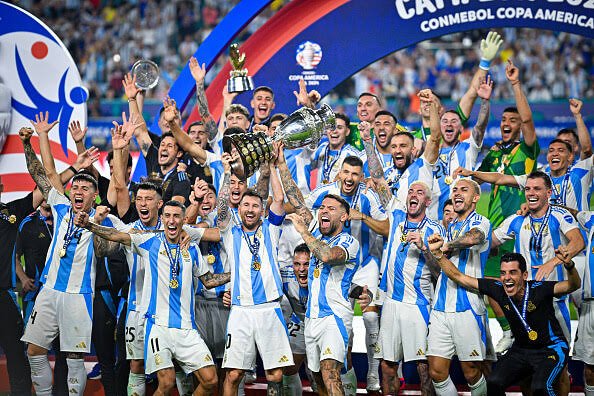
Argentina drop to third in FIFA rankings after a narrow win over Mauritania, as France leapfrog them with a stronger result.
The Argentina national football team have slipped to third place in the latest FIFA world rankings, despite securing a 2-1 victory over Mauritania national football team in an international friendly played on March 28. The result, while positive on paper, exposed a growing concern for the South American giants—winning alone is no longer enough to maintain their position at the top of world football.
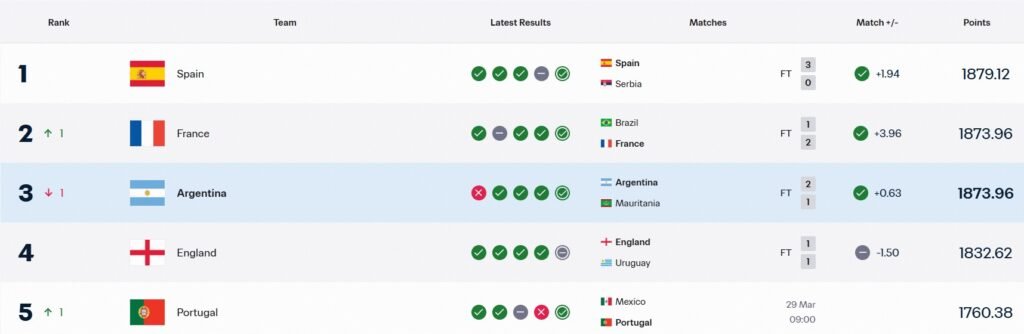
Argentina entered the match ranked second globally, carrying the expectations that come with being one of the most dominant teams of recent years. However, the narrow margin of victory and the relatively low ranking of their opponent meant they gained only 0.63 FIFA ranking points. That modest increase proved insufficient to hold off France national football team, who capitalized on a more competitive fixture to climb above them.
France, who were previously third, arranged a high-profile friendly against Brazil national football team, a side ranked fifth in the world. Their 2-1 victory in that match earned them a significantly higher boost of 3.96 points. This substantial gain allowed the European side to overtake Argentina and move into second place in the real-time FIFA rankings, highlighting the importance of opponent strength in the ranking system.
Looking at the match itself, Argentina started brightly and showed moments of their trademark attacking quality. Midfielder Enzo Fernández opened the scoring in the first half with a composed finish after receiving a well-timed pass from Nahuel Molina. The goal set the tone early, giving Argentina control and confidence as they dictated possession.
Shortly after, rising talent Nico Paz doubled the lead with a beautifully taken free kick. His direct strike demonstrated both technique and composure, reinforcing his growing reputation as one of Argentina’s promising young players. At 2-0, the match appeared comfortably in Argentina’s hands, and many expected them to extend their advantage further.
However, football often punishes complacency. In the closing stages of the game, Mauritania managed to pull one back through Lefort, who capitalized on a chaotic situation inside the penalty area. The goal injected late tension into the match and exposed some defensive lapses from Argentina, who were unable to maintain a clean sheet against a significantly lower-ranked opponent.
While the victory ensured Argentina maintained their winning streak, the overall performance raised questions. The team has now played three recent friendlies against relatively weaker sides—Puerto Rico national football team, Angola national football team, and Mauritania. Across these matches, they collected a combined total of just 1.89 ranking points, despite winning all three games. This highlights a critical flaw in their recent approach: the lack of high-quality opposition.
In contrast, France’s decision to face Brazil reflects a more strategic understanding of the FIFA ranking system. Matches against stronger teams carry more weight, offering greater opportunities to earn points even with narrow victories. Argentina’s conservative scheduling, while ensuring wins, has limited their ability to gain meaningful ranking improvements.
This situation underscores a broader reality in modern international football. Rankings are no longer determined solely by results, but by the context in which those results are achieved. Beating lower-ranked teams yields minimal rewards, while victories against elite opponents can significantly boost a team’s standing.
For Argentina, the drop to third place should serve as a wake-up call rather than a crisis. The team still possesses immense talent, depth, and experience. However, to remain competitive at the highest level—both in rankings and on the pitch—they may need to rethink their approach to friendly matches and seek stronger opponents.
There is also a psychological aspect to consider. Playing against top-tier teams not only improves ranking points but also sharpens tactical discipline and prepares players for high-pressure situations. Argentina’s recent fixtures, while successful, may not provide the same level of challenge required to maintain peak performance standards.
As the international calendar progresses, all eyes will be on how Argentina responds. Will they continue prioritizing easier wins, or will they embrace tougher challenges to reclaim their position among the top two? The answer could define their trajectory heading into future major tournaments.
Meanwhile, France’s rise serves as a reminder that ambition and calculated risk often go hand in hand. By taking on stronger opposition, they have not only improved their ranking but also reinforced their status as one of the most formidable teams in world football.
In the end, Argentina’s drop to third place is less about failure and more about missed opportunity. The talent remains, the victories continue, but in the competitive world of FIFA rankings, not all wins are created equal.