US and Chinese leaders meet as top business executives join high-stakes talks on trade, AI, and global economic power.
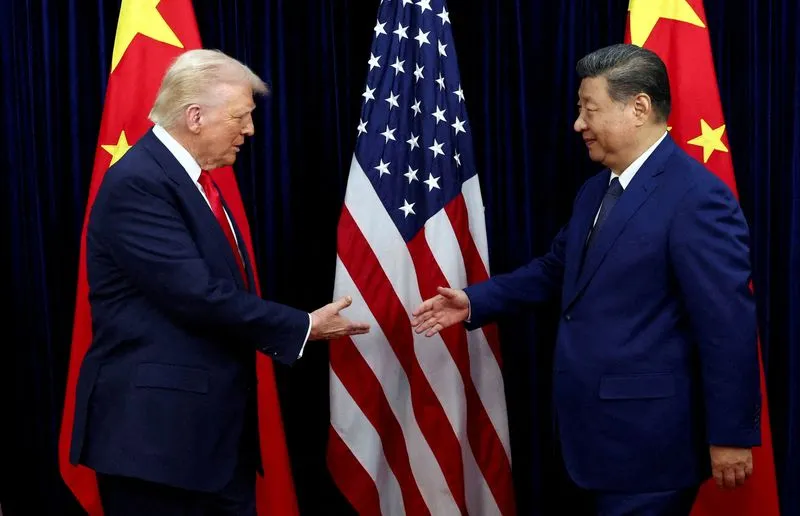
The latest visit by Donald Trump to China is shaping up to be far more than a routine diplomatic trip. Accompanied by some of America’s most powerful business and technology leaders, the US president arrived in Beijing this week for high-level talks with Chinese President Xi Jinping at a time when tensions between the world’s two largest economies remain dangerously high.
The delegation traveling with Trump reflects the enormous stakes involved. Among the executives joining the visit are Elon Musk, Tim Cook, and Jensen Huang, alongside senior leaders from companies including Meta Platforms, Visa, JPMorgan Chase, Boeing, and Cargill. The presence of such influential figures highlights how deeply business interests are tied to the future of US-China relations.
For years, Washington and Beijing have been locked in fierce disputes over trade tariffs, access to advanced technology, and national security concerns. The relationship became even more strained as both countries raced to dominate the global artificial intelligence industry and the semiconductor market that powers it. While tensions eased slightly after temporary trade pauses introduced in late 2025, mistrust between the two governments has never fully disappeared.
This latest meeting between Trump and Xi is therefore being seen as a critical moment for global politics and the world economy. Analysts believe the discussions could determine whether the two nations move toward deeper confrontation or find limited areas where cooperation is still possible.
One of the biggest talking points surrounding the trip is the involvement of Nvidia and its chief executive Jensen Huang. Nvidia has become one of the most strategically important companies in the world because of its dominance in AI chips. These chips are essential for artificial intelligence systems, advanced computing, military technology, and next-generation manufacturing. Both the United States and China see control over such technology as a matter of national power.
Huang’s inclusion in the delegation at the last minute has raised speculation that semiconductor policy could become one of the central themes of the talks. The US has previously imposed restrictions on exporting advanced AI chips to China, arguing that the technology could strengthen Beijing’s military capabilities. China, meanwhile, has criticized the restrictions as unfair economic pressure designed to slow its technological progress.
The presence of executives from the financial sector also signals growing concern within corporate America about the long-term impact of economic instability between the two countries. Major firms such as Goldman Sachs, Citigroup, Mastercard, and Blackstone are heavily invested in global markets that depend on stable US-China relations. Continued disputes over tariffs and technology regulations could create uncertainty for investors and multinational businesses worldwide.
Beyond technology and finance, the delegation includes representatives from healthcare, aviation, agriculture, and logistics industries. Companies like GE Aerospace and Illumina are expected to push for clearer business conditions and improved access to Chinese markets. For many American corporations, China remains one of the world’s largest and most important markets despite the political tensions.
The timing of the visit is also politically significant for Trump. Since returning to office, he has continued to project himself as a leader willing to challenge China aggressively while also positioning himself as someone capable of negotiating major economic deals. Bringing top executives along allows him to present the trip not only as a diplomatic mission but also as an effort to protect American business interests and strengthen economic influence abroad.
For Xi Jinping, the meeting offers an opportunity to stabilize relations with Washington at a time when China’s economy faces slowing growth and increasing international pressure. Chinese officials are expected to seek reassurances that further restrictions on technology exports and trade penalties can be avoided. At the same time, Beijing is unlikely to soften its ambitions in areas such as AI development and advanced manufacturing.
Despite the rivalry, both governments understand that complete economic separation would carry enormous consequences. The US and China remain deeply connected through trade, supply chains, and investment networks that affect millions of jobs around the world. Any major escalation between the two powers could send shockwaves through global markets and damage industries already struggling with inflation and economic uncertainty.
As talks continue in Beijing, the world will be watching closely for signs of progress or deeper division. While few expect a dramatic breakthrough, even small agreements on trade stability or technology cooperation could help reduce tensions between the two superpowers.
For now, Trump’s decision to travel with America’s top corporate leaders sends a powerful message: the battle for the future of global technology, trade, and economic influence is no longer being fought only by politicians. It is increasingly being shaped by the world’s biggest companies and the executives leading them.
#DonaldTrump #XiJinping #USChinaRelations #China #UnitedStates #ArtificialIntelligence #Nvidia #ElonMusk #TimCook #JensenHuang #Technology #TradeWar #Semiconductors #GlobalEconomy #BusinessNews